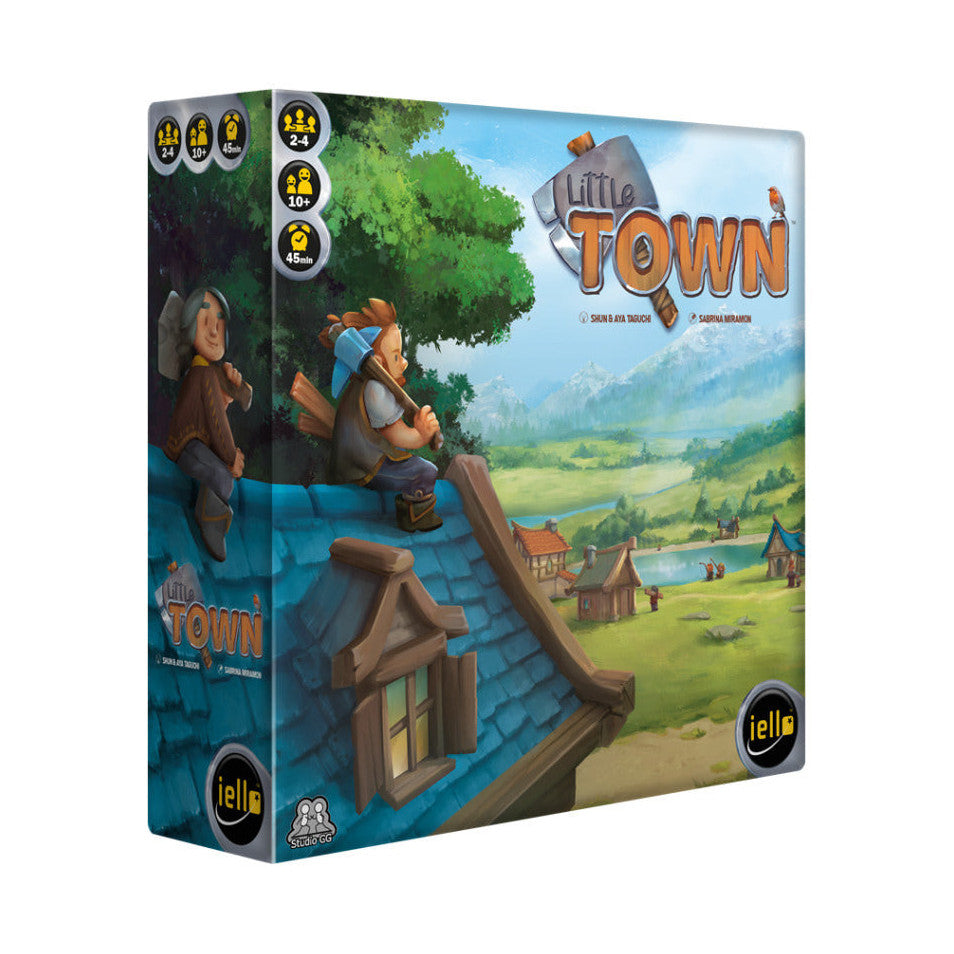
Little Town's unique blend of resource management, city-building, and strategic planning, offers a fresh take on familiar gaming mechanics.
Balancing simplicity with depth, makes it an excellent choice for family game nights or more competitive gaming sessions. For more detail read on.
Game Overview and Setup
Little Town is a game that combines resource management and city-building elements. I've found it to be an excellent choice for both family game nights and it created some memorable competitive sessions.
Components and board layout
The game comes with a main board, various tiles, wooden pieces, and paper tokens. The board features the map with lakes, forests and mountains on it. This is also the building area. Then you have a victory point track, and a round tracker. Wooden pieces include workers, houses, and resource tokens for wood, stone, fish, and wheat. Paper tokens represent coins and victory points.
Player setup and objectives
Each player receives a set of workers, houses, and goal tiles. The number of these components varies based on the player count. For instance, in a three-player game, each player gets four workers, six houses, and four goal tiles. Players also start with three coins each.
Building tiles and resource tokens
The game uses 29 building tiles, including five wheat field tiles. For each game, you randomly select 12 building tiles to use alongside the wheat fields. This adds variability to each playthrough, ensuring a fresh experience every time.
Setting up Little Town is straightforward. You place the selected building tiles and wheat fields in the designated areas on the board. Resource tokens and coins are set aside for easy access. The round marker goes on the first spot on the round tracker, and players place their markers at the start of the victory point track.
Gameplay Mechanics
In Little Town, the gameplay mechanics revolve around worker placement and resource management. Each turn, you place one of your workers either on the main board to gather resources or in the construction area to build. When you place a worker on the board, you activate all eight adjacent spaces, collecting resources like wood from forests, fish from lakes, and stone from mountains. This mechanic allows me to gather multiple resources in a single action, making every placement crucial.
Building construction is a key element of the game. By spending the required resources, you can erect buildings that provide various benefits. Each building you construct not only earns you victory points but also adds new activation options to the board. I particularly enjoy the strategic depth this brings, as you have to consider not only the immediate benefits but also how these buildings might be used in future rounds.
One of the most interesting aspects of Little Town is the feeding mechanism. At the end of each round, I must feed all my workers using either fish or wheat. This adds an extra layer of strategy, as I need to balance resource gathering for building with ensuring I have enough food. Failing to feed my workers results in a hefty penalty of three victory points per hungry worker, which can be quite devastating in a game where every point counts.
The round structure in Little Town keeps the game flowing smoothly. With only four rounds in total, I find that every decision carries weight, and the game maintains a brisk pace throughout.
Strategic Elements
Little Town, whilst being a light worker placement game, can still give the strategic gamer a sense of achievement.
Resource management
Managing resources effectively is crucial in Little Town. It's not just about gathering resources; it's about using them wisely. You often have to decide whether to use your fish and wheat to feed your workers or save them for building activation. This adds an extra layer of strategy to the game.
Building placement tactics
Choosing where to construct buildings is a critical aspect of Little Town's strategy. Placing buildings strategically is the key to creating synergies and scoring opportunities to score on the board. For example, building a wheat farm early can attract other players to build nearby, potentially creating a lucrative centre. You should also consider your opponents' objectives when deciding where to build, as blocking their plans can be just as valuable as furthering your own.
Player interaction and blocking
The shared board in Little Town leads drives player interactions. You can use your opponents' buildings by paying them a coin, which adds an interesting economic element to the game. As the board becomes more crowded, blocking becomes increasingly important. I often found myself weighing the benefits of activating a high-scoring building against denying my opponents access to crucial resources. This interplay between cooperation and competition makes every game of Little Town a unique and engaging experience.
Final Thoughts and Verdict
After spending time with Little Town, I've found it to be a delightful game that offers a fresh take on familiar mechanics. Let's break down the pros and cons, replay value, and recommended player count.
Pros and cons
Little Town shines with its cute wooden pieces and easy-to-teach gameplay. The quick playtime and mix of mechanics work well together, making it an engaging experience.
However, the game isn't without its drawbacks. The use of simple wooden cubes for resources feels a bit underwhelming. Some players might find the game too short, leaving them wanting more. There's also a concern about the limited variety of building tiles, which could impact long-term replayability.
Replay value
Despite the limited building tiles, Little Town offers good replay value. The double-sided board and variable building setups ensure that each game feels different. This dynamic nature keeps the gameplay fresh and challenges players to adapt their strategies. However, an expansion with more buildings and gameplay twists could enhance the longevity of the game.
Recommended player count and experience level
Little Town works well as a family game, accessible to both casual players and strategy enthusiasts. It's an excellent introduction to worker placement mechanics for newcomers. The game supports up to four players, I've found it to be most enjoyable with three or four, as it creates more interesting interactions on the board.
In conclusion, Little Town is a solid choice for those seeking a lighter strategy game with enough depth to keep things interesting. Its blend of resource management, city-building, and player interaction makes it a worthy addition to any board game collection.